
How San Mateo Records Open
California treats a public record as a writing held by a state or local agency that concerns public business, unless a law permits or requires the agency to withhold it. That broad rule does not place all records in one database. San Mateo County ACRE keeps recorded documents, clerk filings, vital copies, assessment data, and election material through distinct divisions. The Superior Court controls case records. City departments keep municipal actions, permits, and police material.
| San Mateo record set | Legal keeper | Web starting point | Full access route |
|---|---|---|---|
| Deeds, liens, maps, notices | ACRE Recorder | RecorderWorks, since 1985 | Free index; office viewing or paid copy |
| Civil, criminal, probate, family, small claims | Superior Court | MIDX and Odyssey | Index or portal; counter and mail copies |
| Birth, death, marriage | ACRE County Clerk; CDPH-VR | Forms and fee pages | In person, mail, or authorized online order |
| Assessment, parcel, tax | ACRE Assessor; Tax Collector | Property Maps and tax lookup | Address or APN search; office copies when needed |
| City actions, permits, archives | City Clerk or city department | Legislative, permit, and request portals | Portal first; CPRA request for missing items |
| Custody and offender data | Sheriff, CDCR, DOJ | Agency lookup tools | Public fields only; separate agency request channels |
An online result can be only an index. The underlying image or case file may still require a counter visit, mailed request, retrieval charge, or certified-copy fee. Vital records add an eligibility split. Voter data has its own purpose limits and belongs on the dedicated San Mateo voter records path.
- Custodian
- The office legally responsible for keeping and releasing a record.
- Index
- A list of identifying facts that points to a document or case, not the full file.
- Certified copy
- A copy that the issuing office formally attests is true and correct.
- Exemption
- A law that permits or requires an agency to withhold some or all requested content.
San Mateo Recorder Index
RecorderWorks is the county's free grantor and grantee index for property documents recorded since 1985. A grantor transfers an interest; a grantee receives it. Searchers may choose either role or both, enter a person's last name followed by first name, allow a partial match, and narrow by date. Separate tabs accept a document number, document type, map, recording date, or book and page.
| RecorderWorks field | Input | Format or option |
|---|---|---|
| Party role | Radio choice | All, Grantor, or Grantee |
| Name | Text | Last name, space, first name; business names accepted |
| Allow Partial Match | Checkbox | Useful for initials and name variants |
| Start Date / End Date | Date | MM/DD/YYYY |
| Document Number | Separate tab | Full number normally begins with the four-digit year |
| Document Type | Separate tab | Requires a date range and type |
The result can show a party name and role, document number, document type, recording date, and a book, page, or map reference when relevant. The county's grantor and grantee information page explains the key limit shown here.
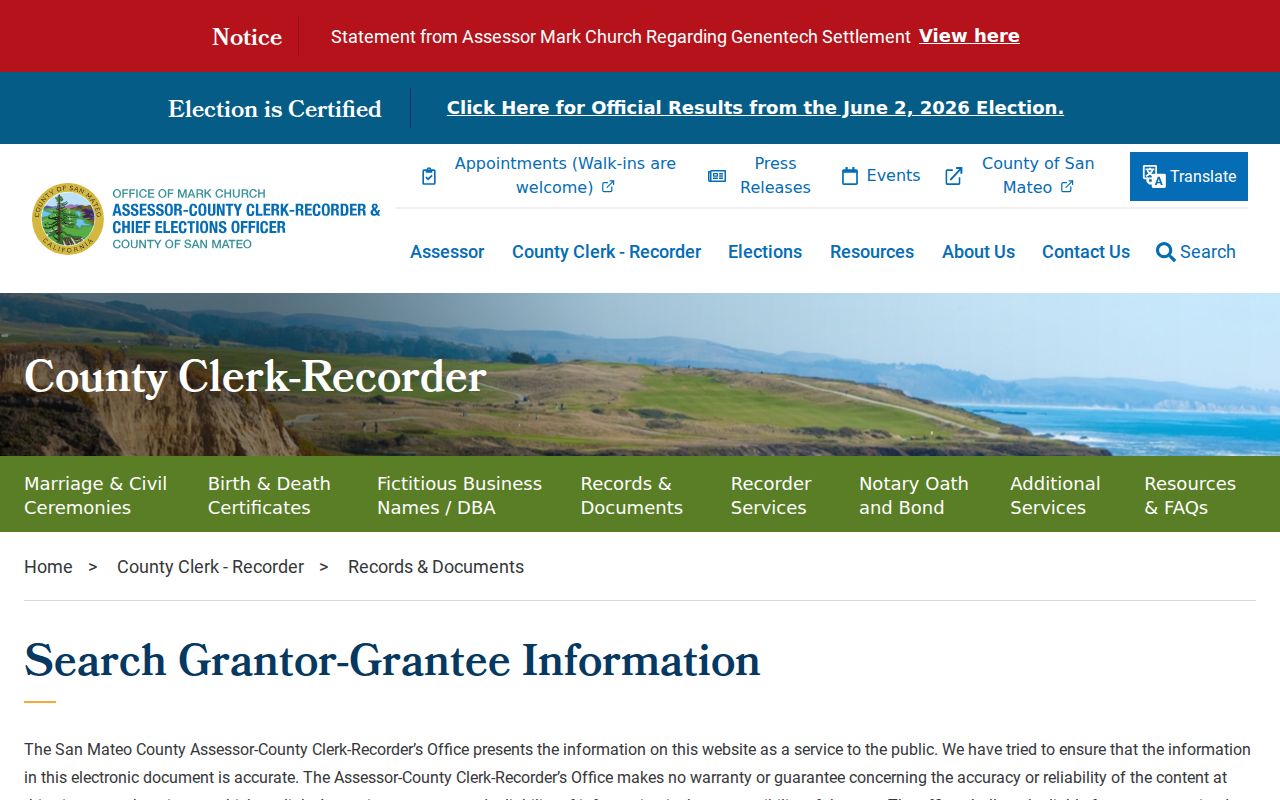
Images are withheld from the online database for privacy. The document itself may be viewed free or copied for a fee at the Recorder office, so a web hit is the reference needed for the next request, not a downloadable deed.
Online does not mean complete. For records before 1985, use the Recorder counter, county archives, or historical collections rather than forcing a modern portal search.
San Mateo Court Record Layers
The Superior Court separates discovery from delivery. MIDX searches nonconfidential, nonsealed appeals, civil, criminal, family law, probate, and small claims indexes. A person search needs at least two characters in both first and last name fields and supports an asterisk wildcard. Business names need at least three characters. Filing-date searches may span no more than five calendar days.
A result normally identifies the case number, party type, case name, filing date, and source of the index data. It is not the docket's full set of filings. The court's Odyssey portals overview shows how MIDX and Odyssey divide online access.
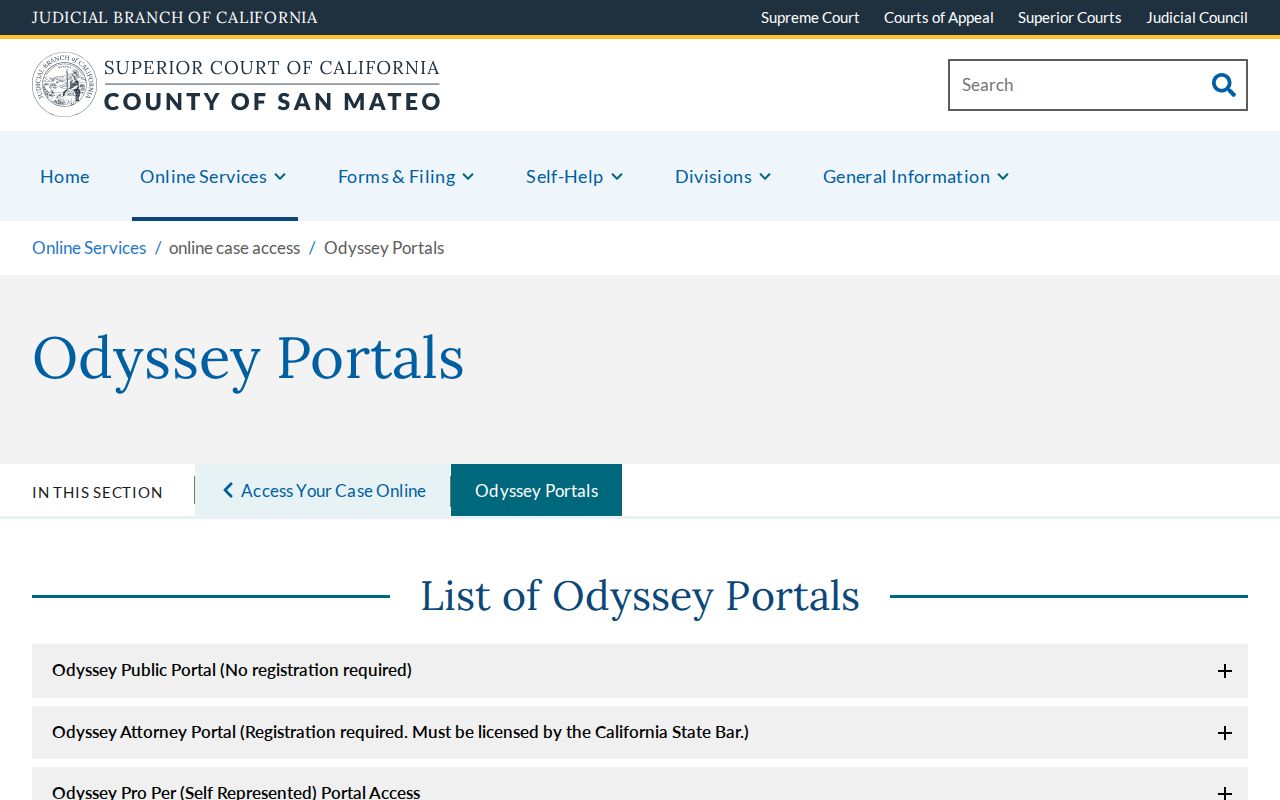
Odyssey can provide more public case information, while Records Management supplies viewed or copied files. Criminal cases filed before 1993 require the Criminal Court Clerk at 650-261-5100, option 1. Off-site files must be requested in person and prepaid, even when MIDX confirms that a case exists.
Does every name hit reveal a complete history? No. Sealed, confidential, and many juvenile or adoption matters do not appear as ordinary public case data. A county court index is also not a statewide record.
San Mateo Vital Record Access
ACRE issues San Mateo County birth, death, and marriage copies, while the California Department of Public Health keeps statewide vital records. California does not use a simple rule that makes every certificate fully open after a set number of years. Health and Safety Code section 103526 limits identity-valid authorized certified copies to qualified people. Other requesters may obtain informational certified copies when available. An original adoption birth record requires a court order.
The county's vital record forms page groups the applications shown below.
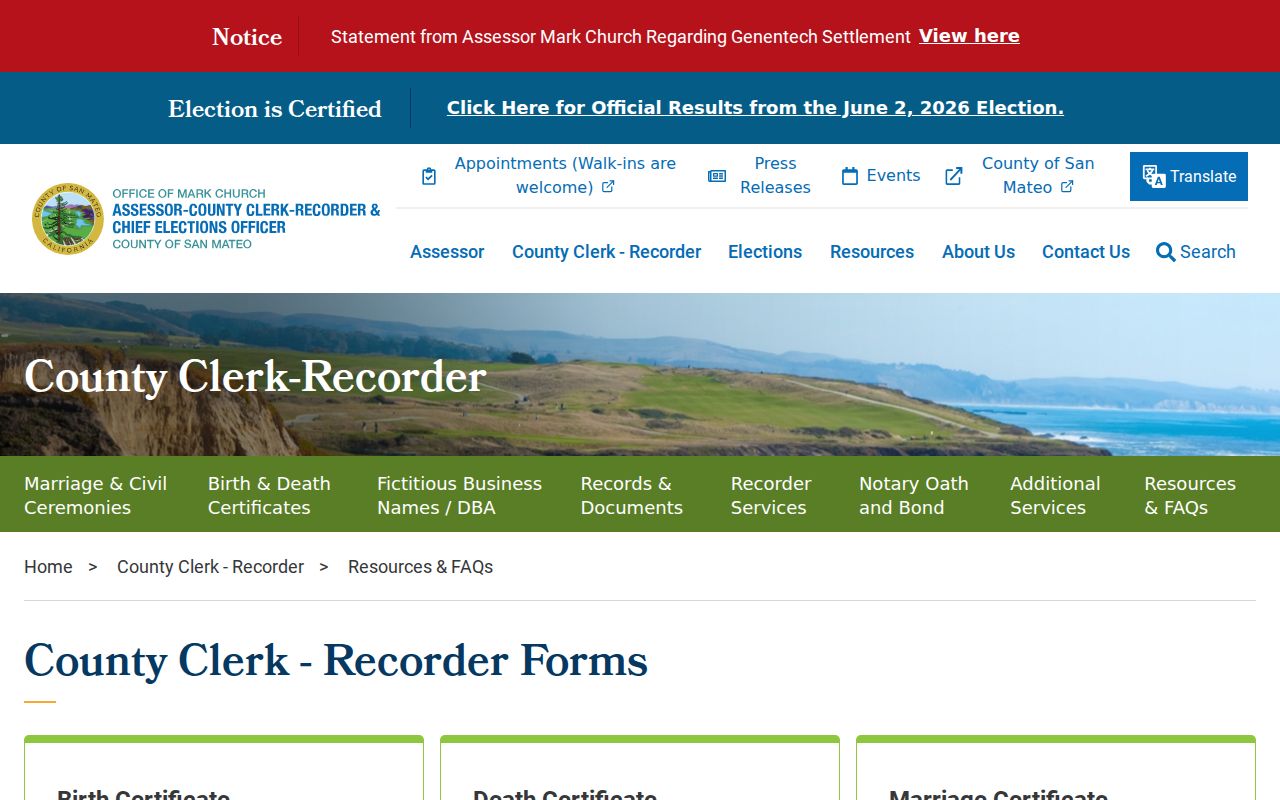
Requests may be made in person in Redwood City, by mail, or through the county's authorized online ordering service. A mail request for an official certified copy needs a notarized sworn statement. Checks or money orders go to the San Mateo County Clerk-Recorder.
The official San Mateo vital records fee schedule sets a separate charge by certificate type.
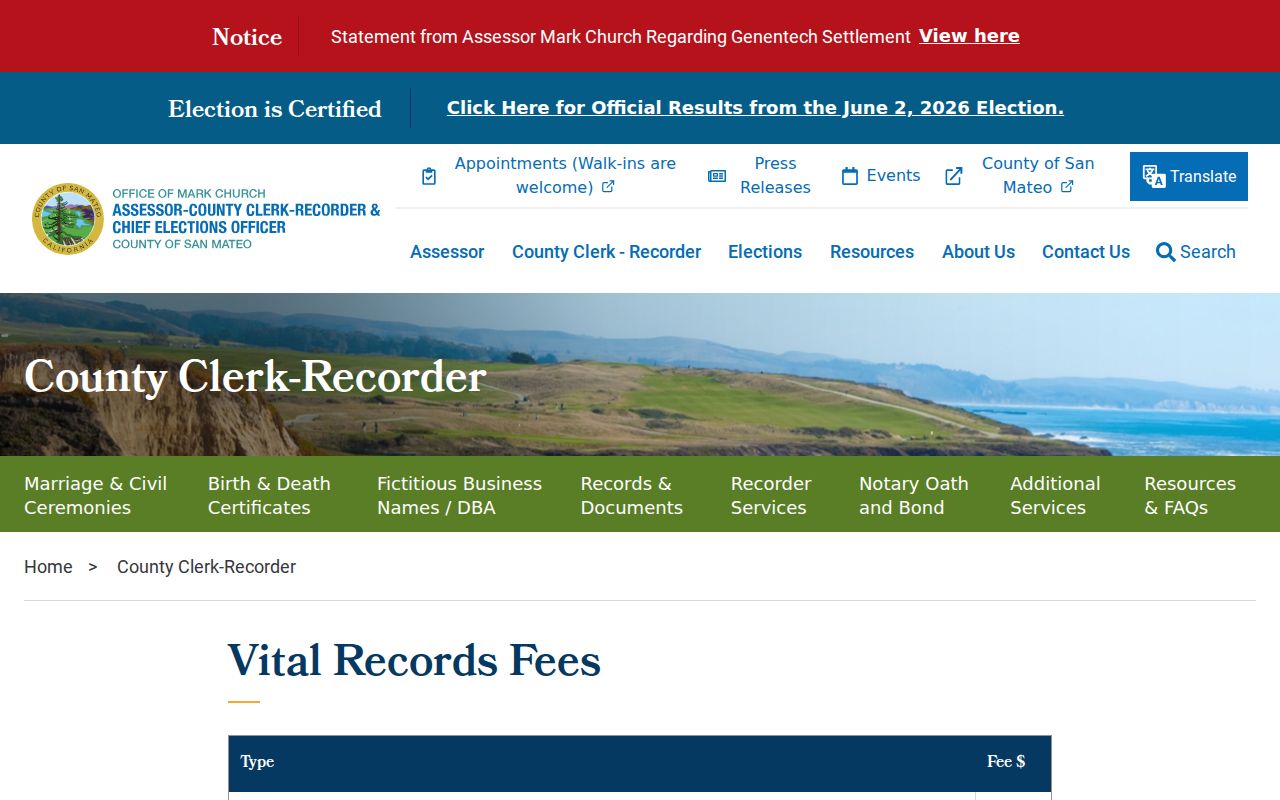
A birth certificate costs $34 for the general public, a death certificate $26, a fetal death certificate $23, and a marriage certificate $19. Search fees mirror the copy charge. If a death record is not found, the fee is retained under Health and Safety Code section 103650 and the office issues a Certificate of No Public Record.
San Mateo Property Record Channels
Property access depends on the starting fact. RecorderWorks is name-first and reveals recorded transactions. The secured tax search accepts an address or assessor parcel number, often shortened to APN. The San Mateo County Property Maps Portal also accepts an address or APN and lets users download assessor maps and recorded subdivision or parcel maps at no charge.
The official sources do not confirm an owner-name search in the assessor or tax portal. Do not treat either tool as a name directory. A situs address means the property's physical location, while a tax mailing address is where the bill goes. The two may differ, and a mailing address does not prove where someone lives.
City permit and code records use the Community Development Customer Self-Service portal. County planning records for unincorporated land use an agency request form by email, mail, or in person. Reproducing official building plans may also require an authorization form and affidavit.
Note: Informal neighborhood names do not replace an address or APN when searching county parcel systems.
ACRE's Four San Mateo Roles
San Mateo County's combined Assessor-County Clerk-Recorder and Chief Elections Officer name hides separate legal custodians. The Recorder handles deeds, liens, maps, notices, and other recorded instruments. The County Clerk issues vital copies, marriage services, fictitious business names, and several registrations. The Assessor builds the assessment roll and maintains map access. Elections manages registration and election material.
This structure is a local records geography issue. San Mateo is not the county seat. The main ACRE campus is in Redwood City, and choosing the wrong division can delay a request even when every page bears the same ACRE brand. Use the record type, not the agency logo, to pick the counter.
Older material may sit elsewhere. Recorder books from 1857 through 1872 have a finding aid through the Online Archive of California and an off-site UCLA Special Collections workflow. That archive path is distinct from the modern county counter and the since-1985 web index.
San Mateo Public Records Offices
Each office below owns a different part of the system. The shared Redwood City address does not make the Recorder, County Clerk, Assessor, and court interchangeable. Call ahead for the current counter procedure when a file must be pulled from storage.
ACRE Recorder Division
555 County Center, 1st Floor
Redwood City, CA 94063
(650) 363-4500
ACRE County Clerk
555 County Center, 1st Floor
Redwood City, CA 94063
(650) 363-4500
The City Clerk handles municipal archives, council records, and boards and commissions. Search the city's legislative portal for minutes, resolutions, ordinances, and agenda reports before opening a new CPRA request. County deeds, county vital copies, and Superior Court files do not move to City Hall merely because the person or property is in San Mateo.
San Mateo Record Copy Costs
Recorder copies cost $5 for the first page of each document and $1 for each added page of that same document. Certification is extra. Office viewing is free. In-person payment may be made by cash, check, or Visa or Mastercard credit or debit card. A mailed Recorder request requires a preprinted check payable to the San Mateo County Clerk-Recorder.
Court Records Management charges $0.50 per side for a copy, $40 to certify a copy of a paper or proceeding, $15 for a certified dissolution record, $15 when a search takes more than ten minutes, and $10 to retrieve an off-site file. Comparing a copy with its original costs $1 per side. These court charges do not apply to Recorder documents or county vital certificates.
For CPRA requests, agencies may recover permitted direct duplication costs, but each office uses its own schedule. The ten-day period under the act is a determination deadline, not a promise that all responsive pages will be ready in ten days.
Note: Ask for an index result first when it can supply the document or case number needed for a precise copy order.
Custody and Safety Lookups
County custody status begins with the Sheriff's Inmate Locator, which the City of San Mateo describes as real-time name access for people held by county facilities. Incident and agency records follow a different route: the Sheriff's Office accepts Public Records Act requests through a web form or a physical form sent by email. Court filings from a criminal case belong to Superior Court, not to the sheriff request channel.
California's CIRIS tool covers people now in state custody and can return a name, CDCR number, age, current location, commitment counties, admission date, and parole hearing information. Federal custody uses the federal locator for records from 1982 forward.
The official California Megan's Law website displays only offender information that Penal Code section 290.46 permits the state to disclose.
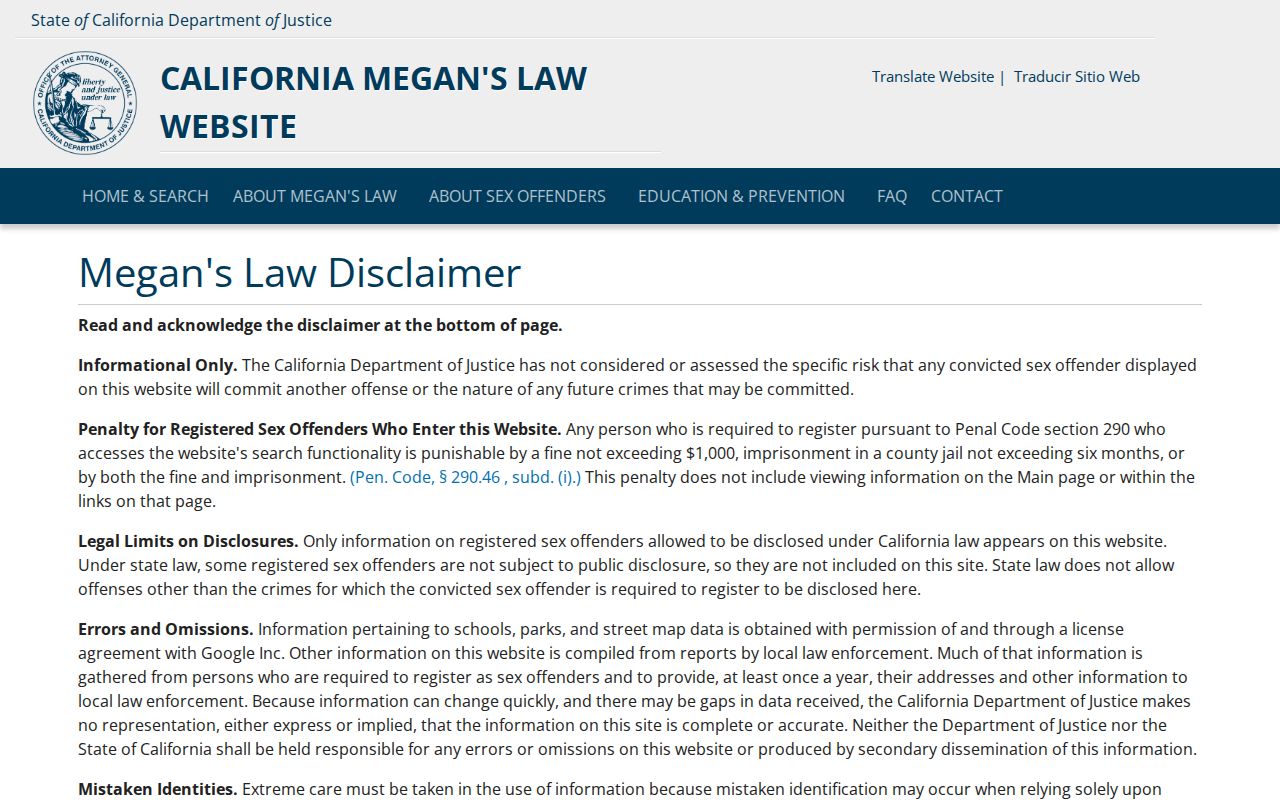
The disclaimer screen is part of the access boundary. Some registrants are not subject to public disclosure, unrelated offenses do not appear, and registry information is limited to public-safety awareness.
Use records lawfully. Never use a custody, court, deed, or registry result to stalk, harass, threaten, or harm a person. Follow each agency's stated limits.
Confidential Records in California
CPRA does not override every privacy law. Sealed and confidential cases, juvenile files, adoption records, protected family-law details, and information made confidential by another statute may be withheld. Driver records carry federal and state privacy limits. RecorderWorks deliberately keeps document images off the web. A public index entry is not proof that every fact within the source document can be released without redaction.
Vital-copy limits protect identity-valid certificates. Voter-file releases withhold driver license numbers, Social Security numbers, and signatures, and exclude confidential voters. Safe at Home can provide a substitute mailing address and confidential voter status to qualified participants facing danger.
California's DROP program concerns registered commercial data brokers. It can send a deletion request to hundreds of participating brokers, but it does not erase a lawful deed, court entry, or government archive. Corrections to official material must go to the office that keeps the record.
San Mateo Records Fraud Alerts
Recorded-document access can also prevent fraud. San Mateo County ACRE warns that private firms may charge for services the Assessor or Recorder provides free or at a lower official rate. A mailed deed offer is not the county copy desk. The current Recorder schedule gives a clear benchmark: $5 for the first page and $1 for each added page of one document.
Suspected forged transfers, false recorded documents, or other real estate fraud may be reported through the county District Attorney's Real Estate Fraud channel. ACRE also maintains a real estate fraud alert and consumer warning. Recording fee materials note that the Real Estate Fraud Prosecution Fee increased on January 21, 2025, so an older quoted recording total may no longer be current.
Use the State Controller's official unclaimed property system for a free claim. The state says there is no deadline and no state fee to recover property. Confirm the government domain and official fee page before paying for any search, form, or copy.
Request San Mateo Public Records
The California Public Records Act, Government Code section 7920.000 and following, lets any person request disclosable records from state and local agencies. An agency generally has ten days to determine whether it holds responsive, disclosable material. Unusual circumstances can add fourteen days. Production must be prompt, but a large or archived request can take longer than the initial determination.
- Name the custodian. Send city material to the City Clerk or department, county recorded items to the ACRE division, sheriff material to the Sheriff's Office, and case files to the court.
- Check the purpose-built portal. Search the legislative archive, RecorderWorks, MIDX, property maps, or permit system before filing a broad request.
- Describe the records. Give names, dates, addresses or APNs, case or document numbers, record type, and a useful date range. State the preferred electronic or paper format.
- Use the right channel. The city has an online portal; county planning accepts email, mail, or in-person forms; the sheriff offers web and emailed forms. Courts and vital copies use their own procedures.
- Review cost and scope. Approve lawful copy, certification, or retrieval charges. Narrow an unclear request if the office identifies a better record description.
- Address a withholding. Ask the agency to identify the exemption and release any reasonably separable nonexempt parts. Agency review or court action may be available.
A generic CPRA request is not always the fastest route. Use a vital application for a certificate, a Recorder copy order for an indexed document, and Records Management for a case file. Those channels already ask for the facts that the custodian needs.